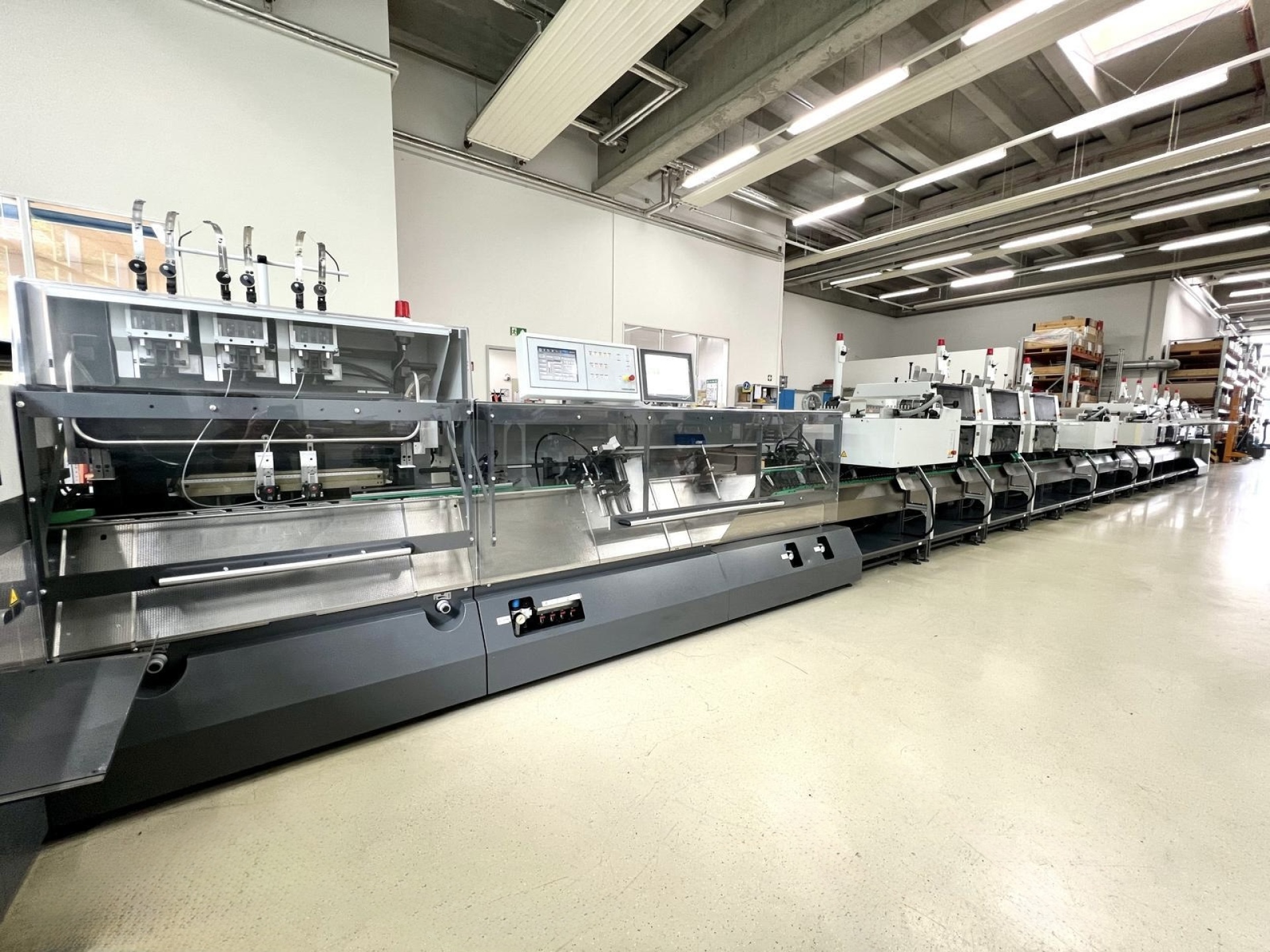
When Taylor Corporation's high-volume bindery in Bloomington, Minnesota needed a new saddle stitcher, they didn't settle for off-the-shelf. The result was a fully custom-configured Heidelberg Stitchmaster ST 450 — overhauled, commissioned, and tested in Germany before crossing the Atlantic — backed by a spare parts guarantee that sealed the deal.
One of the largest privately held companies in the United States, Taylor Corporation has spent five decades growing from a single print shop in North Mankato, Minnesota into a national communications powerhouse. Today the company operates more than 90 production facilities across the country, employs nearly 10,000 people, and produces everything from two billion direct mail pieces a year to hundreds of millions of business cards. At the Bloomington plant — operating under the Corporate Graphics Commercial banner — the focus is high-volume commercial print and finishing: stitched booklets, magazine inserts, direct mail, business reply cards. It is exactly the kind of operation where a saddle stitcher runs hard, runs long, and cannot afford to be the bottleneck.
Configured to the last detail
When the Bloomington team began specifying their next saddle stitcher, they approached the process the way most printers approach a new machine purchase — with a precise list of requirements. Four vertical feeders. Four horizontal feeders. Three cover feeders. Barcode and image recognition cameras integrated inline for automatic quality inspection. It was a configuration built for complexity: multi-signature jobs, mixed feeder types, zero tolerance for undetected errors. The only difference was that the machine in question was a Heidelberg ST 450 from the discontinued Stitchmaster line.
That level of custom specification on a discontinued model is unusual. It demands a supplier capable of more than sourcing — one who can engineer, overhaul, and validate the result before it leaves the workshop. allaoui took on exactly that scope.
Overhauled, commissioned, shipped
The ST 450 was brought to allaoui's facilities and fully rebuilt. Every element of Taylor's custom configuration was installed and integrated. The machine was then run in production conditions in Aachen — tested, validated, and signed off — before being prepared for export. Only once it met Taylor's specification did it ship to the United States.
Upon arrival in Bloomington, allaoui's team completed the installation on-site and supported the plant through a full week of live production. For Taylor's operators — already familiar with Heidelberg's saddle stitching platform through their existing ST 400 — the transition was structured to be as close to a new machine handover as possible.
The guarantee that closed the deal
For a plant running at the volumes Taylor Bloomington handles, the machine itself is only part of the equation. Before committing, the team had a clear condition: spare parts availability had to be guaranteed. Long lead times on critical components are not an operational risk they were willing to accept.
allaoui was able to give that assurance — and immediately demonstrated it. Parts for Taylor's existing ST 400, components that typically carry extended delivery windows elsewhere, were sourced and delivered quickly. It was a proof of capability that arrived before the ink on the contract was dry.
That track record has held. Since the ST 450 was commissioned, Taylor Bloomington has maintained an active spare parts relationship with allaoui — servo motors, frequency converters, PLC modules, delivery belts, knife kits, sensors — a steady flow of components that keeps both machines running without interruption.
A partnership, not a transaction
What began as a demanding specification for a single machine has become something more durable: a supply partnership built on reliability. For a company that prints at Taylor's scale, that kind of consistency in the supply chain is not incidental — it is structural.